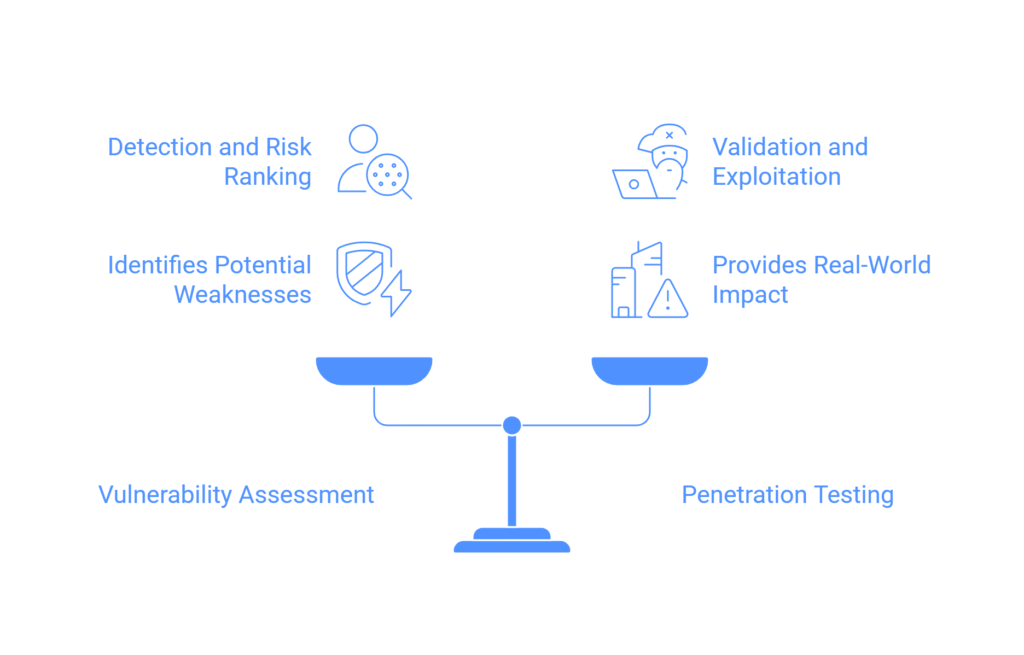
Vulnerability Assessment and Penetration Testing (VAPT) is a comprehensive security evaluation approach that combines automated scanning and manual testing to identify, analyze, and exploit security weaknesses in an organization’s IT infrastructure. It covers systems, networks, and applications to reveal vulnerabilities before attackers can exploit them. While Vulnerability Assessment focuses on detection and risk ranking, Penetration Testing validates these findings through controlled exploitation, providing deeper insight into real-world impact and remediation priorities.
Business Problem and Challenges
Inadequate Security evaluations
Incomplete security evaluations leaves unidentified gaps, loopholes, misconfigurations in Network Infra / Security solutions / Servers and Applications such as Web / Mobile / APIs / Thickclients / Mobile / Payment Gateways that leads to Insider and Cyber Attacks Inability to identify the attack surface and vectors increase the threat landscape and affect the overall organization security posture
Lack of skilled resources
Experienced and Specialized resources are needed in performing VAPT activities using automated tools / manual methods in identifying the vulnerabilities and whether they can be exploited or not in order to secure Applications / Network Infra in production
Security Non-Compliance
Applications / Infra that are hosted with limited quality and security affects overall organization’s business / audit / legal / regulatory requirements and standards that they must comply with, such as ISO, NIST, HIPAA, GDPR, PCI, SOC2, etc
Not adhering to Security practices affect customer trust and may lose overall business
VAPT Services
VAPT Use-Cases
Vulnerability Assessment
Vulnerability Assessments using automated tools and manual methods to find security gaps, loopholes, misconfigurations in Network Infra / Security solutions / Servers / Applications such as Web / Mobile / APIs / Thickclients / Mobile / Payment Gateways.
Assessment include checks on OS, Kernel, Apps installed, Libraries, software programs, packages, utilities, security misconfigurations, patching.
Exploit, Penetrate and Remediate
Non-intrusive Penetration testing using automated tools and manual methods to verify the identified vulnerabilities can be exploited and what impact it creates
Provides complete picture of existing security controls efficiency and effectiveness in detecting and preventing the simulated testings
Security Compliance
Organization’s business / audit / regulatory requirements to comply with Application security controls of various security frameworks / standards such as ISO, NIST, HIPAA, GDPR, PCI, SOC2, etc
Establish customer trust in generating or continuing the business
Scope and Business Benefits
Scope
Network or Application hosted in On-Prem / Cloud
Consideration of Security frameworks / standards / compliance checks according to requirements
Automated scans and Manual testing’s
White-box / Black-box testing’s
Detailed recommendations/resolutions for all the findings
Consulting and Support for fixing vulnerabilities
Benefits
Prioritization of Resources
Identification of Vulnerabilities and quantifying its impact